Below the Waterline: The Great Salt Lake’s Hidden Pollution Crisis
When people talk about the Great Salt Lake’s environmental crisis, the conversation usually focuses on water levels — the shrinking shoreline, the record lows, the dire projections for what the lake could become if current trends continue. That framing is accurate and important. But it is incomplete. Beneath whatever water remains in the lake, there is a second crisis unfolding: a century and a half of human activity has deposited metals, chemicals, debris, and submerged structures on the lake floor, and that accumulation does not stay put.
Research has documented that metals and chemical compounds flushed into the Great Salt Lake’s tributaries — from industrial operations, agricultural runoff, urban stormwater, and other sources — flow into the lake and become concentrated in the lakebed sediment. The lake acts as a terminal basin, meaning water flows in but, under natural conditions, never flows out. Everything that arrives in the lake tends to stay. Heavy metals including arsenic, selenium, and mercury have been found in the lakebed at concentrations that concern researchers studying both ecosystem health and human exposure risk.
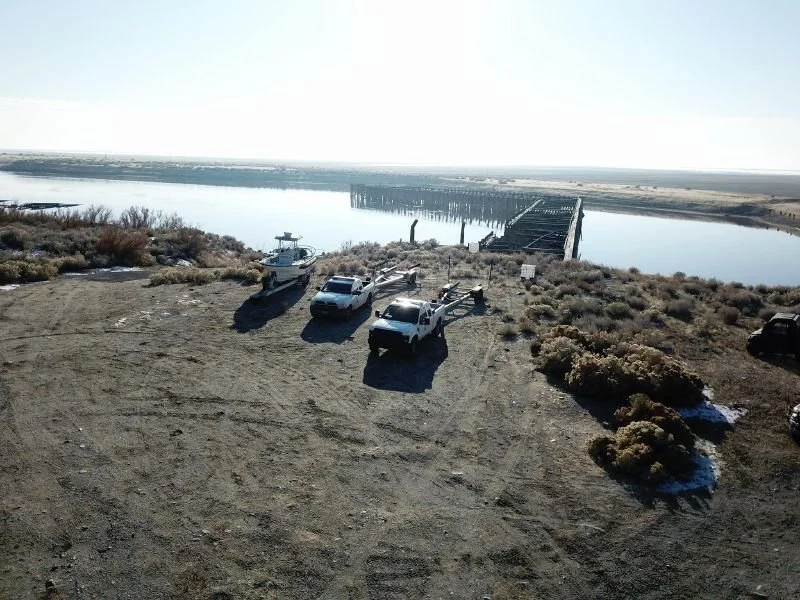
But this is not only an industrial emissions story. Human activity on the lake itself has contributed to that contamination profile. Vessels that sank and were never recovered. Aircraft that went down and were left on the floor. Equipment lost during construction operations. Vehicles driven onto the ice and lost when the ice gave way, or launched from poorly graded ramps and slipped beneath the surface. Every one of those objects added its own contamination signature to the lake’s sediment — fuel, oil, battery acid, heavy metals from engines and airframes, antifouling compounds from boat hulls.
The connection between submerged debris and the lake’s broader dust problem is not widely understood, but it is real. As the lake recedes, lakebed sediments that were once underwater become exposed and can dry into fine particulate matter. That dust, carried by wind across the Wasatch Front, contains the same metals and compounds that accumulated in the sediment over decades. Removing submerged debris before the lake drops further is not just an aesthetic or historical exercise — it is a public health measure. Every hull, vehicle, or piece of contaminated equipment recovered from the lake floor is one fewer source of pollutants in the sediment that will eventually become airborne dust.
The Great Salt Lake is not a static pond. It is a dynamic ecosystem that connects to the broader water cycle, to migratory bird populations that depend on it for critical habitat, and to the communities of the Wasatch Front through the air they breathe. What happens in the lake does not stay in the lake. The brine shrimp and brine flies that form the base of the lake’s food chain absorb whatever is in the water and sediment. The birds that eat those organisms carry those compounds further. The dust that lifts off the drying lakebed carries them into lungs.
This is the environmental case for the work Fathom Restoration does. We are a disabled-veteran-led Utah 501(c)(3) nonprofit focused on recovering submerged vehicles, vessels, aircraft, and debris from Utah’s lakes and waterways. We do this work because the underwater pollution problem is real, because no other organization is specifically focused on it in Utah, and because the Great Salt Lake — already fighting for its survival — deserves advocates who are willing to address all of the challenges it faces, not just the visible ones.
The water level is the crisis everyone sees. The lake floor is the crisis no one is looking at. We are looking.
Fathom Restoration is a disabled-veteran-led Utah 501(c)(3) nonprofit dedicated to lake cleanup and the recovery of submerged vehicles, vessels, and debris from Utah’s lakes and waterways. Donate / Volunteer / Report a vehicle at fathomrestoration.org.
Source: https://www.ksl.com/article/46231720